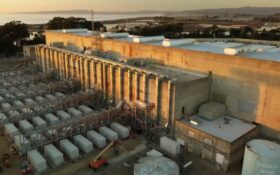
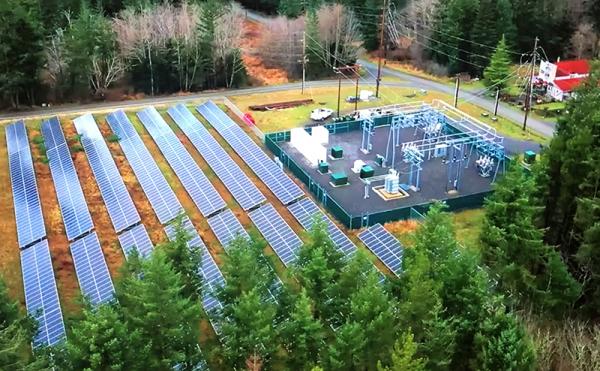
Orcas Power and Light Cooperative (OPALCO) has installed a 1MW/2.6MWh lithium iron phosphate battery storage system to supply around four hours of power to 500 homes on the US north coast.
The energy storage system (ESS) on Decatur Island, Washington, sits alongside a 500kW community solar microgrid set up in 2018 and is the first of many microgrids planned for the San Juan Islands. OPALCO’s long-range plan is to install seven microgrids by 2040.
The project will help avoid or defer undersea cables and reduce peak load, thus extending the life of electric equipment and reducing peak charges. The savings, plus a $1 million grant from Washington State, will more than cover the cost of installation.
Imre Gyuk, director of energy storage at the Department of Energy’s office of electricity, explained that the microgrid would provide local energy to smooth out variations in power from the mainland.
Suzanne Olson, OPALCO’s public relations administrator, commented: “While we will always be tied to mainland power, for our lives in San Juan county, this microgrid, and the ones to follow, will decrease our dependency on mainland power and give us more control of local power.”
Power cuts cost the San Juan Islands about $3.5 million per year according to OPALCO. The next installation planned is for a project covering at least 3.8 acres on San Juan Island. Funds have been approved for a 2MW/4MWh battery storage system next to a community solar array.
OPALCO plans to build more microgrids near all villages where essential services are located. The utility will be able to re-route the power to the essential facilities and critical infrastructure. Foster Hildreth, OPALCO general manager, said: “The more microgrids that we can integrate into our system, the more power we are going to have for emergency services.”
Electric ferries
The cooperative utility— which has 20 islands in its service territory and serves about 15,150 electric meters— intends to have enough capacity to also serve Washington’s ferries, which are being converted to a hybrid electric fleet
Washington ferries— the largest ferry system in the US— will be retiring 16 diesel ferries and replacing them with hybrid electric new builds, and converting six others to plug-in hybrid, with recharging capacity at 16 ports.
All hybrid vessels will be able to charge at terminals and some will be capable of operating fully electric, on the shorter routes. The American shipbuilder Vigor Fab LLC has selected Swiss company ABB as the hybrid electric propulsion and high capacity energy storage system (ESS) provider.
ABB has chosen Spear’s flexible modular batteries as the preferred technical solution for the vessels. The installed battery capacity on the Olympus class ships will be approximately 10MWh each. The lithium-ion battery racks and converters will be on shipboard systems while the ESS on port terminals will be able to utilise renewable energy sources.